





Saham News
IHSG Today: Market Outlook & Top Stock Picks for Friday, May 8, 2026
/index.php
Crypto News - Posted on 05 February 2025 Reading time 5 minutes
Bitcoin is at risk of a significant correction due to escalating global trade tensions, triggered by new import tariffs between the United States and China. Market sentiment has deteriorated, leading to high volatility in the crypto market, making Bitcoin increasingly unstable.
A document released on Tuesday (4/2/2025) stated that China’s Ministry of Finance would impose a 15% import tariff on various US goods, set to take effect on February 10, 2025.
This move comes in response to an executive order signed by US President Donald Trump on February 1, 2025, which imposed additional tariffs on goods from China, Canada, and Mexico. The escalation of this trade war has heightened concerns in the global market, directly impacting risky assets, including Bitcoin.
As a result, Bitcoin’s price plunged from US$100,000 to US$92,800, rebounded to US$101,000, and later corrected to its current level at US$98,200.
Analysts warn that Bitcoin remains at risk of a deeper correction below US$90,000, driven by rising trade uncertainties and inflation concerns.
According to Cointelegraph, Ryan Lee, Chief Analyst at Bitget Research, stated that China’s tariff decision could exacerbate volatility in risky assets such as Bitcoin.
"Escalating trade tensions could weaken traditional markets, prompting investors to seek Bitcoin as a hedge against inflation and currency depreciation. However, a broader sell-off due to economic uncertainty could trigger a short-term correction, potentially pushing Bitcoin below US$90,000," Lee explained.
Meanwhile, James Wo, Founder and CEO of DFG, noted that historically, import tariff policies from major economies have often caused significant market declines.
"In the short term, there is a risk of a deeper correction below US$90,000, not only for Bitcoin but also for equities and commodities," Wo said.
However, Wo also highlighted that a prolonged trade war could weaken the US dollar and drive inflation higher, ultimately increasing global demand for Bitcoin as an alternative asset.
To avoid heightened volatility, Bitcoin needs to maintain its position above US$97,000. If the price drops below this level, CoinGlass data indicates that over US$1.3 billion in long positions could be liquidated across exchanges, potentially triggering a larger sell-off.
According to Lee, Bitcoin and other risky assets may face additional pressure if the stronger US dollar due to tariff policies attracts more capital outflows from the crypto market.
"The key factor to watch is monetary policy. If the Federal Reserve responds by cutting interest rates to counter economic pressure, increased liquidity could serve as a catalyst for Bitcoin’s price recovery," he added.
Additionally, higher import tariffs could exacerbate inflation concerns and disrupt global supply chains, further strengthening Bitcoin’s appeal as a hedge against market volatility.
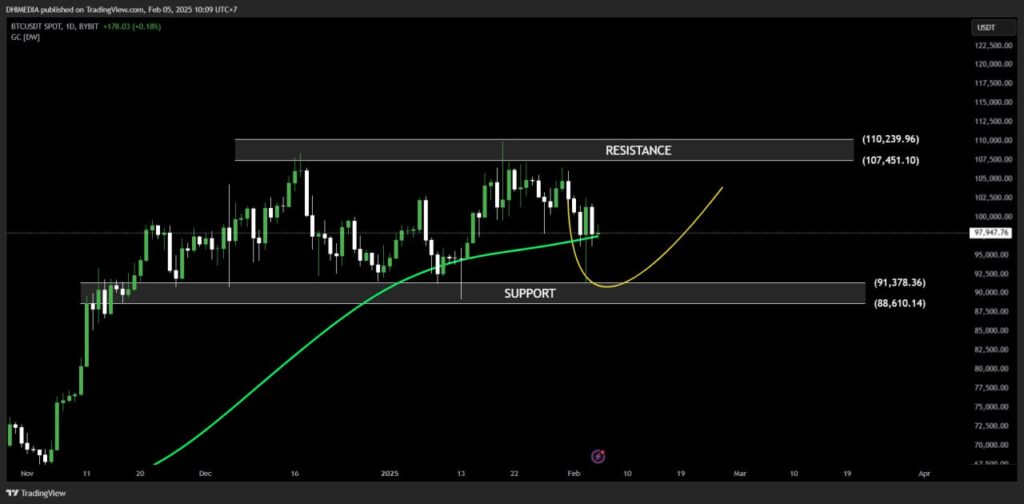
Meanwhile, analysis from Coinvestasi shows that Bitcoin’s support level currently stands at US$88,600 – US$91,300, with a potential rebound.
The next resistance target is set between US$107,400 and US$110,000.
Market participants now await further developments from the meeting between US President Donald Trump and Chinese President Xi Jinping, aimed at easing trade tensions and preventing a full-scale trade war, which could significantly impact global financial markets.
Temukan berita dan artikel lainnya di Google News
Source: coinvestasi.com
What do you think about this topic? Tell us what you think. Don't forget to follow Digivestasi's Instagram, TikTok, Youtube accounts to keep you updated with the latest information about economics, finance, digital technology and digital asset investment.
DISCLAIMER
All information contained on our website is summarized from reliable sources and published in good faith and for the purpose of providing general information only. Any action taken by readers on information from this site is their own responsibility.
SHARE
VIEW