





Saham News
Bareksa Analysts Pick PSAB and BBCA, Here's Their Outlook for the IHSG
/index.php
Bisnis | Ekonomi - Posted on 13 March 2026 Reading time 5 minutes
The International Energy Agency (IEA) plans to release 400 million barrels of oil to compensate for supply disruptions caused by the closure of the Strait of Hormuz amid the military conflict involving the United States and Israel against Iran.
The announcement was made on Wednesday (March 11) by IEA Executive Director Fatih Birol after the Iranian government threatened that it would not allow “a single liter of crude oil” to pass through the maritime route that normally carries more than 20% of global oil supplies.
Birol stated that the 32 member countries of the IEA had agreed to release the largest coordinated oil reserves in the organization’s history.
Despite this measure, oil prices rose again on Thursday (March 12). Brent crude surged by more than 9% during trading in Asia, briefly surpassing US$100 per barrel before correcting to around US$97.50.
The IEA is an international organization that coordinates energy policies and strategic oil reserves among 32 industrialized countries, most of which are advanced economies in Europe, North America, and the Asia-Pacific region.
The announcement came after the blockade in the Strait of Hormuz had continued for several days. In the past few hours, several attacks were reported against three cargo ships in the area. At least one of those attacks was claimed by Tehran.
At the same time, Iraq reported that two foreign oil tankers were also attacked at one of its ports.
A few hours after the IEA statement, the United States government announced it would release 172 million barrels of oil from its emergency reserves as part of a coordinated international effort to reduce global energy prices.
Shipments from the U.S. strategic reserves are expected to begin next week and will continue for approximately 120 days.
“The scale of the challenge we are facing in the oil market is truly unprecedented. That is why I am very pleased that IEA member countries have responded with a collective emergency action that has never been taken before,” Birol said.
The IEA explained that the emergency reserves would be released into the market gradually according to each member country's national conditions.
The 400 million barrels of oil are equivalent to roughly four days of global consumption or the amount that would normally pass through the Strait of Hormuz over about 20 days.
This marks the sixth time the IEA has approved a coordinated release of oil reserves. Previous releases occurred in 1991, 2005, 2011, and twice in 2022.
According to the agency, IEA member states hold more than 1.2 billion barrels of emergency reserves, in addition to about 600 million barrels maintained by the oil industry to meet legal requirements set by national governments.
Brent and WTI oil prices were around US$60 per barrel before the conflict in Iran erupted on February 28, a level considered historically low due to abundant supply.
The conflict pushed prices above US$100 per barrel, although they temporarily fell to the US$80–US$90 range in recent days.
However, new attacks launched by Iran in the past few hours against tankers attempting to pass through the Strait of Hormuz pushed crude prices back above US$100.
At the start of trading on Thursday, Brent rose more than 9% in Asian markets and briefly exceeded US$100 before retreating to around US$97.50.
Meanwhile, gasoline prices have increased in almost every country, and many governments are preparing emergency measures in case the energy crisis worsens.
On Wednesday (March 11), Iran announced it had ended its policy of reciprocal military strikes and would instead focus on blocking the Strait of Hormuz.
Analysts interpret this strategy as an attempt to leverage control over the strait to drive up oil prices and raise the cost of war for the United States and its allies.
Tehran’s new policy will now involve “strike after strike,” according to Ebrahim Zolfaqari, spokesperson for the Khatam al-Anbiya military command headquarters.
He stated that Iran would not allow “a single liter of oil” to pass through the strait toward the United States, Israel, or their allies.
“Any ship or tanker heading toward them will become a legitimate target,” he warned.
He also cautioned that oil prices could reach US$200 per barrel because energy prices depend on regional security that has been disrupted.
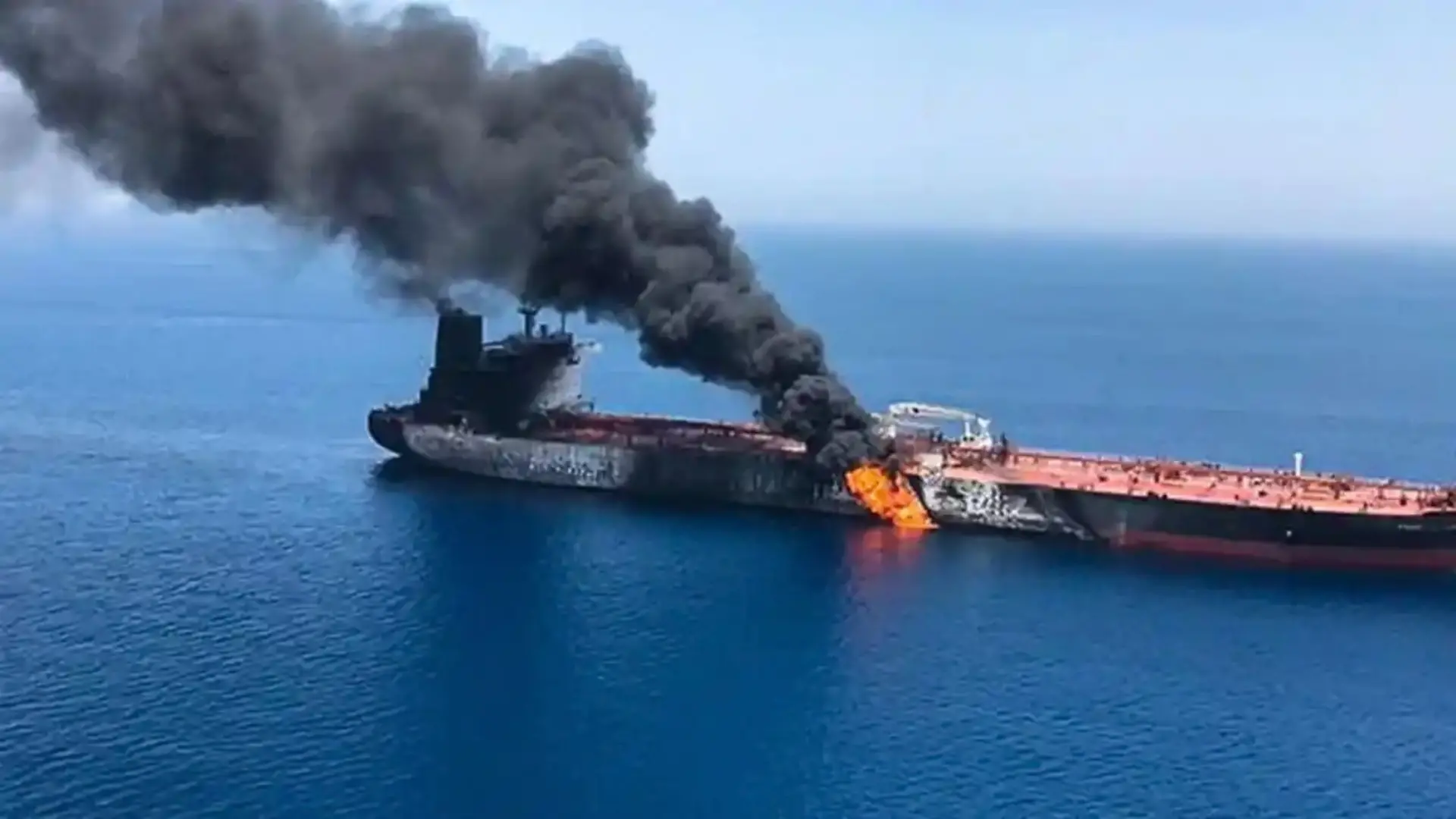
On Wednesday, three ships were attacked in the Strait of Hormuz. Two vessels were damaged, while another— a Thai-flagged cargo ship named Mayuree Naree—caught fire after being struck near the coast of Oman.
Thai maritime authorities reported that the vessel was hit by a projectile that triggered a fire onboard. Oman’s navy was deployed to assist with rescue operations and evacuate the 20 crew members.
All crew members were Thai nationals, and three of them were reported injured.
Iran claimed responsibility for the attack.
Shortly afterward, Iraq’s armed forces spokesperson reported that one crew member was killed and 38 others were rescued after two foreign oil tankers were attacked at Al-Faw Port.
“Two tankers were targeted in a cowardly act of sabotage,” said Lieutenant General Saad Maan, as quoted by the Iraqi News Agency (INA).
He added that the attack occurred within Iraqi territorial waters and constituted a violation of the country’s sovereignty.
An Iraqi security source in Basra told CNN that an Iranian vessel carrying explosives was believed to have collided with the two ships, although investigations are still ongoing.
Iraq’s State Organization for Marketing of Oil expressed deep regret over the incident, while authorities temporarily halted operations at the oil port following the attack.
Meanwhile, the UK Maritime Observatory reported that 13 vessels have been attacked in the Strait of Hormuz and the Gulf of Oman since February 28.
U.S. President Donald Trump described the rise in oil prices as “a small price” to pay for eliminating the threat posed by Iran’s nuclear program.
“Short-term oil price increases, which will quickly fall once the destruction of Iran’s nuclear threat is complete, are a very small price to pay for security and peace for the United States and the world. Only a fool would think otherwise,” Trump wrote on Truth Social.
He also stated that U.S. forces had “struck 28 mine-laying vessels so far,” referring to Iranian ships allegedly prepared to deploy mines against commercial vessels in the Strait of Hormuz.
The U.S. military, which has been searching for ways to reduce threats to maritime traffic in the strait, also signaled the possibility of strikes on ports along Iran’s southern coastline.
The United States Central Command (CENTCOM) warned Iranian civilians to immediately stay away from all ports along the strait where U.S. naval forces are operating.
CENTCOM stated that Iran was using civilian ports for military activities that threaten international shipping.
“These dangerous actions endanger innocent lives,” the warning said.
CENTCOM also emphasized that civilian ports used for military purposes lose their protected status and become legitimate military targets under international law.
Previously, CENTCOM released images showing what it described as 16 Iranian mine-laying vessels destroyed near the Strait of Hormuz.
Trump also told Axios on Wednesday that the war would end “soon” and that “there is practically nothing left to attack.”
“Whenever it ends, it ends,” he said.
Meanwhile, Israeli Defense Minister Israel Katz stated that the war would continue indefinitely.
He argued the conflict would proceed as long as necessary until all objectives of the joint Israel–United States campaign launched on February 28 are achieved.
In response to the situation, several oil-producing countries in the Middle East are seeking alternatives to deal with the crisis in the Strait of Hormuz.
Saudi Arabia has increased crude oil flows through its East–West pipeline network, while other Gulf producers have chosen to reduce output, according to BBC News Middle East correspondent Sameer Hashmi reporting from Riyadh.
The 1,200-kilometer pipeline transports oil from Gulf fields to export terminals on the Red Sea, reducing reliance on the Strait of Hormuz.
Before the current crisis, the Saudi East–West pipeline carried about 2.8 million barrels of oil per day.
Amin Nasser, CEO of Saudi Aramco, said on Tuesday that the company is now increasing flows close to its maximum capacity of around 7 million barrels per day. At the same time, tanker shipments are being redirected to Saudi ports on the Red Sea.
Saudi Arabia and the United Arab Emirates are among the few producers that have pipeline networks capable of bypassing the Strait of Hormuz.
The Abu Dhabi Crude Pipeline in the UAE can transport about 1.8 million barrels per day to the Port of Fujairah on the Gulf of Oman.
However, even at full capacity, the pipelines of Saudi Arabia and the UAE can carry less than half the volume of crude oil that normally passes through the Strait of Hormuz.
Other Gulf producers without similar alternatives—such as Kuwait and Iraq—have begun reducing production.
Amin Nasser described the disruption as “the biggest crisis the regional oil and gas industry has ever faced.”
Source: bbc.com
What do you think about this topic? Tell us what you think. Don't forget to follow Digivestasi's Instagram, TikTok, Youtube accounts to keep you updated with the latest information about economics, finance, digital technology and digital asset investment.
DISCLAIMER
All information contained on our website is summarized from reliable sources and published in good faith and for the purpose of providing general information only. Any action taken by readers on information from this site is their own responsibility.
SHARE
VIEW